1 Step into a recognisable situation
The participant gets a role in a realistic scenario, for example as a team lead, supervisor, service employee or technical specialist.

Interactive scenarios in which employees practise difficult decisions and experience the consequences of their choices.
In practice, not every decision is simple. Employees regularly have to choose between interests that collide. Safety or speed? Customer satisfaction or following a procedure? Often there is no single answer that is right in every situation.
With Dilemma Storytelling, Preludens develops interactive stories in which employees practise this kind of trade-off. They step into a recognisable situation, make choices and discover what their decisions mean for different goals and the people involved.
That creates a safe learning environment in which teams can practise and reflect before similar situations happen in practice.

Many organisations invest in knowledge transfer. Employees learn procedures and ways of working. They follow training and get an explanation of the responsibilities that come with their role.
But daily practice is rarely as tidy as an instruction. What do you do when a customer asks for an exception? When a safety measure causes delay? Or when two important goals cannot be met at the same time?
In those moments employees have to do more than reproduce knowledge. They have to understand the situation, recognise interests, estimate consequences and make a decision.
The challenge lies mainly in making a sound trade-off when interests collide. Knowing the rules is not enough for that. That skill is hard to train with explanation alone, or with a traditional knowledge test.
That is why Preludens develops learning experiences in which participants can practise the complexity of real decisions. A MicroGame can help someone carry out a procedure correctly. Dilemma Storytelling lets them experience what happens when that procedure collides with time pressure, customer interests, safety or other responsibilities.
A choice is often more complicated than it first appears. Below you can explore one situation. It is a shortened, fictional scenario, not a completed project. In a real Dilemma Story the story develops further and earlier choices carry into later situations.
Fictional scenario
You are a team lead. An important job has to be finished today. The customer is counting on delivery, but an employee reports that a safety check is not yet complete.
What do you do?
Dilemma Storytelling is a form of scenario-based learning. Participants move through realistic scenarios and make decisions that change how the story continues. More about how we combine learning and play is on our method page.
The participant gets a recognisable role in a situation where several interests are at play. A problem arises that asks for a choice. Every decision has consequences for the story, the people involved and the goals that matter in that situation. Think of safety, quality, speed, customer satisfaction and collaboration.
Not every choice is simply right or wrong. Sometimes a decision improves one result while another goal comes under pressure. By making those consequences visible, participants discover how interests connect and why professional action asks for careful trade-offs.
A Dilemma Story takes the participant through recognisable situations in which decisions change what happens next. There is room to explore possibilities, and a clear frame so the learning stays focused.
The participant gets a role in a realistic scenario, for example as a team lead, supervisor, service employee or technical specialist.
Interests collide. A customer asks for speed while quality is under pressure, or a procedure stands in the way of an urgent solution.
Every option has its own trade-off. There is not always one answer that gives the best result on every point.
The choice changes the story: in how the people involved respond, in the situation and in the goals that matter.
Earlier decisions open possibilities, but can also create limits. The participant has to look and act again.
Which goals were reached, where did risks appear, and what other approach might have been possible?
In practice, choices often affect several goals at once. An organisation wants to work safely and carefully, and still deliver on time. Those goals can collide.
That is why we link decisions inside a Dilemma Story to specific goals. Participants see how choices and consequences connect. A high score is not the goal.
Dilemma Storytelling prepares employees for situations in which knowledge, behaviour and decision-making come together.
Dilemma Storytelling is valuable when employees have to act while different interests, responsibilities or risks come together.
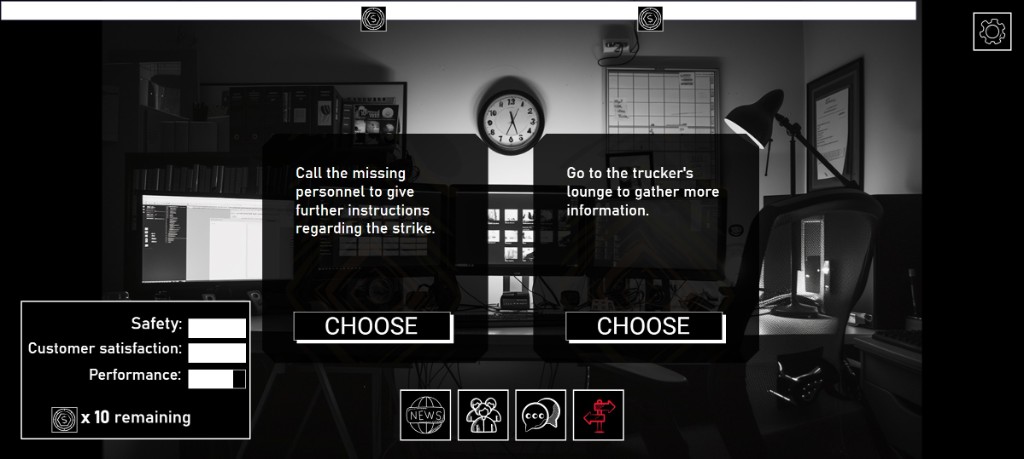
For TU Delft we developed The Disruption Game: an interactive Dilemma Story about a logistics disruption. Participants do not have all the information, have to choose and see how that choice plays out in safety, customer satisfaction and performance.
There is not one answer that solves the disruption. The scenario shows what happens when you look for more information, give instructions or take another route, and which interests shift as a result.
A good Dilemma Story starts with a recognisable tension from practice. We explore where employees have to make difficult choices and which behaviour the organisation wants to strengthen.
Which decisions are difficult, which interests are involved, and where do risks or recurring problems appear?
For example recognising interests, judging risks, explaining choices or understanding the consequences of a decision.
A recognisable story with roles, responsibilities and tensions. The participant has to decide in order to move forward.
We decide what consequences each choice has for the story, the people involved and the goals inside the scenario.
We look at whether the situations are recognisable, the trade-offs have meaning and the feedback fits the learning goals.
Through an existing learning environment or through Prepo. Where it fits, choices give insight into how the training unfolds.
Both learning formats combine storytelling with active participation. The starting point differs.
MicroGame Stories are aimed at transferring, practising and anchoring concrete knowledge. Participants follow a visual story and practise with short MicroGames around specific learning goals. That fits technical knowledge, procedures, onboarding and work instructions.
Dilemma Storytelling focuses on situations in which several interests are at play at once and not every choice has one clearly right answer. Participants explore possible ways of acting and experience the consequences. That fits leadership, safety, customer contact, supervision and professional action.
Which approach fits depends on the learning challenge. Sometimes employees need to learn to apply knowledge. Sometimes they need to get better at handling complex decisions. In some programmes the two forms complement each other. When the task itself is not yet sharp, we start with Game Thinking: first get a clear view of behaviour, goals and what needs to change.
Dilemma Storytelling can be a standalone learning experience, or part of a wider training or change programme. For example as preparation for a workshop, as practice in a leadership programme, or as a deeper step after an existing e-learning module.
Participants can explore a situation on their own beforehand. In a shared session the choices they made are discussed. Why did someone choose a particular approach? Which interests were given priority? How would a colleague judge the same situation?
That way the interactive story also becomes a starting point for dialogue and shared reflection. Distribution and management can run through an existing learning environment or through Prepo.
An interactive form of learning in which participants move through realistic scenarios, make choices and experience the consequences of their decisions. It practises decision-making, weighing interests and reflection on professional action.
Scenario-based learning is the broader approach in which participants learn from realistic situations. Dilemma Storytelling is Preludens' application of that, centred on a narrative structure, meaningful choices and visible consequences. The emphasis is on situations in which interests collide.
No. With complex dilemmas there is not always one solution that gives the best result on every point. Participants explore which trade-offs are possible. Some decisions can still conflict with important rules, safety conditions or professional responsibilities.
Yes. Different choices can lead to other reactions, consequences or follow-up situations. Which branches are needed is decided from the learning goals and the complexity of the scenario.
Yes. Recognisable situations from the organisation are the starting point. Together with subject experts we explore which dilemmas lend themselves to an interactive learning experience.
Yes. The learning experience can be done individually and then become the basis for shared reflection. That makes different perspectives inside a team discussable.
Choices can be linked to the goals in the scenario, for example safety or customer satisfaction. Which information is recorded depends on the technical solution and the agreements about data use.
The cost depends on the number of scenarios, the complexity of the choices, the number of storylines and the desired design. In a first exploration we look at which scale fits the learning goals and the resources.
Yes. One bounded dilemma can be a first exploration. That shows whether the situation is recognisable, which choices have meaning and how the consequences are best made visible. From that experience a fuller scenario can grow.
Are there situations in your organisation where employees regularly have to make difficult decisions? Situations in which safety, quality, speed, customer satisfaction or collaboration collide?
In a GameStorm we explore the main tensions, the audience and the behaviour you want. That gives a first direction for a Dilemma Story.