
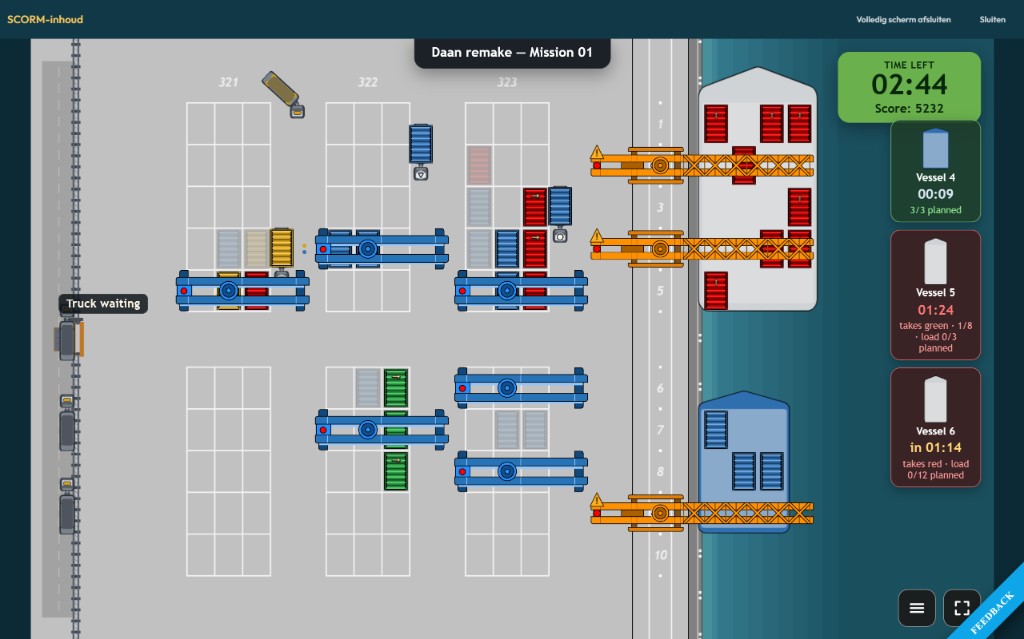
A container terminal looks orderly at first glance. Ships arrive, containers are unloaded and new containers go on board.
But behind every movement there is a plan.
Where do you place a container in the yard? Which crane do you use? How do you avoid unnecessary moves? And what does a choice now mean for the ship that should depart again as soon as possible?
Together with TU Delft we are working on Yard Crane Scheduler: a MicroGame in which participants experience for themselves how choices in a container terminal affect each other.
What makes this project special? We developed the first version about fourteen years ago. More than 20,000 missions have been played since. In 2026 we are rebuilding the game for a next generation of players.
The situation
Behind every container there is a choice
Different logistics processes come together on a container terminal.
Containers are unloaded from ships, moved across the terminal by vehicles and stored temporarily in the yard. Other containers need to be available at the right moment to go back on board a departing ship.
Every decision has consequences for the next step.
Place a container in an awkward spot and cranes and vehicles later have to cover greater distances. If a delay appears somewhere, it can carry through into other parts of the process.
To understand terminal operations well, it is therefore not enough to know the separate parts. You especially need to learn to see how they affect each other.
The challenge
Understanding complexity by playing with it
The processes behind a container terminal can be explained at length with models, diagrams and simulations.
But for education an important question then appears: how much complexity does a participant need in order to actually understand the system?
Yard Crane Scheduler originally grew out of exactly that challenge.
Instead of simulating the full reality, we bring the question back to the choices that matter. The player gets control of a terminal yard and has to discover how container placement, crane movements, transport and ship planning are connected.
The complexity does not disappear.
It becomes playable.
The design question
How do you make terminal planning understandable without making it too simple?
The central design question is:
How can we let participants experience what influence their planning choices have on the efficiency of a container terminal?
For that, the player should not only see how a terminal works.
The player has to plan.
Make choices.
And then experience what those choices cause further on in the process.
That makes Yard Crane Scheduler a MicroGame: a bounded play experience in which one logistics challenge is central and the player gains more grip on the system through action and feedback.
The route
From logistics process to game mechanism
In Yard Crane Scheduler the player is responsible for the placement and movement of containers within a terminal yard.
{“The goal is clear”=>”make sure ships can be handled as efficiently as possible.”}
That means the player has to think ahead.
A container that arrives now has to be put in a smart place. Yard cranes need to be able to move efficiently. Transport movements should stay as short as possible. And containers a ship needs have to be available at the right moment.
The score makes visible how well those different choices come together.
Players earn points by processing containers correctly and handling ships efficiently. Containers that are not loaded, unloaded or moved away in time have a negative effect on the result.
The score is therefore not a separate game element, but feedback on the chosen strategy.
The experience
First choose. Then see what happens.
The strength of the MicroGame is the direct relationship between choice and consequence.
The player thinks up a strategy, sets up the yard and then sees the logistics process start to move.
Does the chosen layout work?
Do cranes have to cover long distances?
Do bottlenecks appear?
Are the right containers available when a ship needs them?
By playing again, the participant can try another strategy and compare the result.
That creates a safe setting in which to experiment. Not by giving all the answers first, but by letting participants discover patterns themselves.
The result
More than 20,000 missions played
Yard Crane Scheduler was developed about fourteen years ago as one of the first MicroGames by Preludens.
Since then the game has been used in logistics education for different audiences, and more than 20,000 missions have been played.
That makes the project special for us.
Not only because of the lifespan of the game, but above all because the original play principle still holds: give participants a clear goal, let them make choices themselves and use the consequences of those choices as feedback.
In 2026 we therefore started a full redevelopment together with TU Delft.
The technical foundation is being renewed, the visual style is being sharpened and the scoring and level system, among other things, are being developed further. At the same time the original gameplay is kept as much as possible.
Not redesigning because we can, but keeping what works and renewing what is needed.
The insight
A good MicroGame does not make everything simpler
Yard Crane Scheduler shows us what a MicroGame can do with complex knowledge.
The aim is not to rebuild a container terminal in full. The aim is to find exactly those parts with which a participant can experience the most important principle.
For that you sometimes have to leave things out.
By bringing reality back to goals, choices, rules and immediate feedback, there is room to discover. Participants do not only see what happens inside a logistics process, but also experience why their own decisions matter.
We still use that principle when designing MicroGames.
From loose information to a learnable experience.
From an explanation of a process to trying, adjusting and playing again.
Which knowledge in your organisation would you want to make playable?
Not every learning challenge calls for a large simulation.
Sometimes the most important learning experience sits in one process, one skill or one recurring choice.
With MicroGames we bring that core forward and design an environment in which participants can actively discover, choose, practise and grow.
Together we look for the game that is already hidden in your practice.
Project details
- Client
- TU Delft
- Sector
- Education and logistics
- Type of solution
- MicroGame
- Theme
- Container terminal planning and logistics
- Learning goal
- Plan more efficiently to shorten the turnaround time of ships
- Role of Preludens
- Game design, interaction design, art and technical redevelopment