
From abstract refrigeration to active learning
How do you make complex professional knowledge understandable and applicable, without simplifying the content?
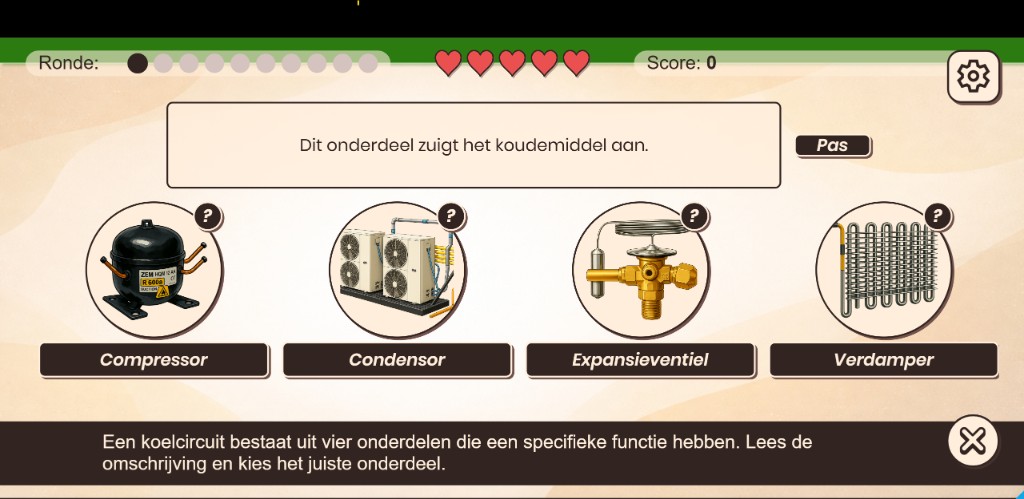
For Basic Refrigeration we developed, together with Climatools BV, 21CC Learning and Studium, a digital learning experience in which installation technicians do not only receive refrigeration theory, but actively work with it.
From knowing the theory to recognising it in practice
Demand for heat pumps, air conditioning and sustainable cooling systems is growing. At the same time, working in refrigeration calls for specialist knowledge.
Concepts such as the mechanical refrigeration cycle, superheat, subcooling and the h-log-P diagram are essential, but can stay abstract when participants mainly learn them from a book, a presentation or traditional e-learning.
An installation technician ultimately needs to do more than reproduce the theory. Participants need to recognise components, understand relationships, interpret information and connect that knowledge to situations from their work.
That is why the project turned on one central design question:
How do we make complex refrigeration knowledge accessible, interactive and applicable, so participants not only understand how the refrigeration cycle works, but also learn to recognise it in their work?
First decide what someone needs to be able to do, then design
We did not start by building games.
In design workshops we mapped the content and learning goals together with the experts involved. We kept looking past the question of what someone needs to know.
We explored what participants needed to be able to do with that knowledge.
From there we translated the subject matter into concrete challenges. Those became the basis for nine MicroGames around different parts of refrigeration.
The MicroGames were tested by subject experts during development. They reviewed the technical content, terminology and situations, among other things. With their feedback we refined the games further.
Prepo was an important link between designing, testing and improving. Through Prepo we could make new versions available and keep sharpening them throughout the development process.
We then developed two storylines to place the different learning activities in a recognisable context. 21CC Learning translated these stories into images and finally brought all the parts together in the learning platform.
Subject matter → learning goals → challenges → MicroGames → test and improve → stories → learning experience
First understand, then choose and apply
The final learning experience consists of two storylines containing nine MicroGames.
The stories give context to the refrigeration knowledge. The MicroGames are the moments when participants take the lead.
They receive an explanation, but then also have to look, analyse, make connections and choose. They get immediate feedback on those choices.
A concept such as superheat, for example, is not only explained. The participant has to use the knowledge inside a concrete challenge and gains insight into what a choice means.
The learning experience is therefore set up as practice, not only as working through theory.
Stories give meaning and coherence. MicroGames create a safe setting in which to apply knowledge, make choices and try again.
Nine MicroGames, two stories, one learning route
The project resulted in a digital learning experience for Basic Refrigeration in which subject matter, storytelling and active practice come together.
We developed nine MicroGames, tested and refined with subject experts during development. We also developed two storylines, which 21CC Learning worked out visually.
The stories, MicroGames and other learning content were then brought together in the 21CC Learning platform.
In this way the original subject matter was translated into a learning route in which participants do not only receive information, but have to do something with it again and again.
Which knowledge do people in your organisation need to learn to apply?
Many organisations already have the content. The knowledge sits in training programmes, documents, procedures or in the heads of experts.
But knowing is not yet the same as being able to apply it.
That is why at Preludens we do not start with the question of which game we can make. We first explore what people need to recognise, understand, choose or do in their work.
From there we design a learning route in which stories give context and MicroGames invite people to practise actively with the knowledge.
Which complex knowledge do you want to take from theory to application?
Project in brief
- Client
- Climatools BV
- Partners
- 21CC Learning · Studium
- Our role
- Learning design · MicroGame development · Storytelling
- Developed
- 9 MicroGames · 2 storylines
- Services
- Game Thinking · MicroGames · Storytelling
- Delivered
- 2026