
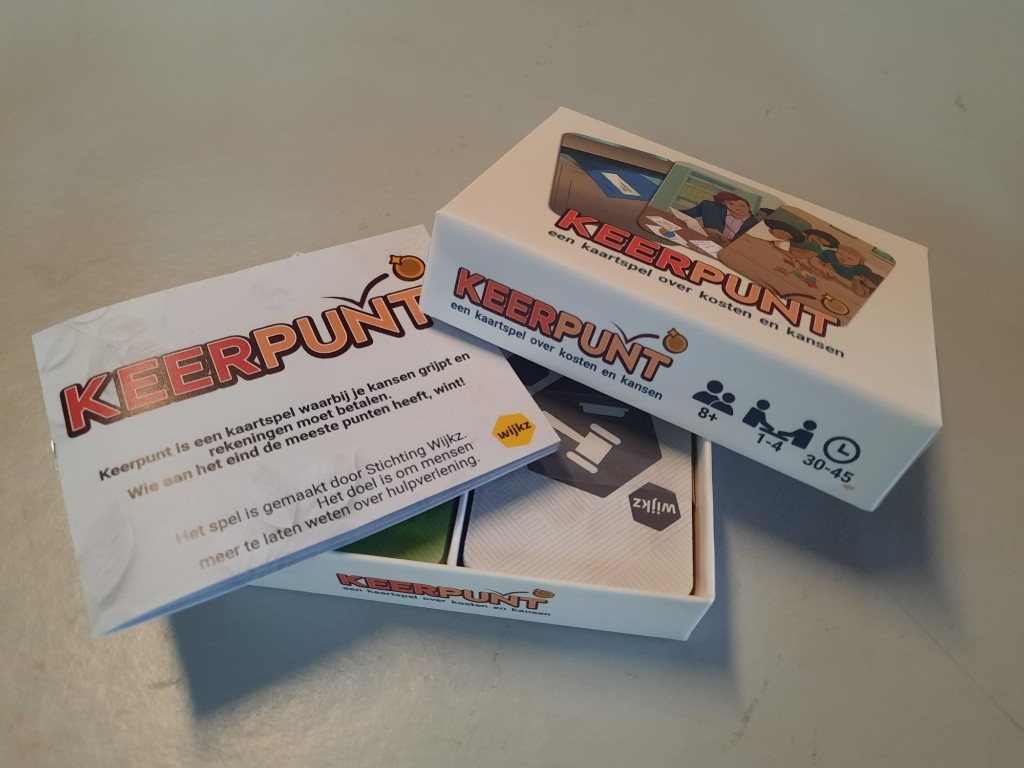
Keerpunt
What happens to your choices when money worries take up more and more room?
A bill you cannot pay. An unexpected setback. Too little energy to solve everything. And meanwhile ordinary life just continues.
From the outside a solution sometimes looks simple: ask for help, make a plan, tackle the problem.
But how simple is that still when worries pile up and you feel less and less room to look ahead?
With Keerpunt we developed a card game that lets players experience what financial and emotional pressure can do to people. Not to tell them how poverty feels, but to create a situation in which participants notice for themselves what happens when income, energy and focus come under pressure.
The situation
A good conversation does not always start by itself
Professionals who work on livelihood security want to help people. But first a conversation has to start.
And that is exactly where a barrier can sit.
The reality of someone with financial worries is often more complex than an overview of income, expenses and debts. Stress, uncertainty, shame and a lack of mental space play a part in the choices someone makes.
As a support worker you can know that those factors exist.
But that does not yet mean you experience what they do to your ability to make choices.
That is the starting point of Keerpunt.
The challenge
Can you create understanding by letting someone experience it?
We did not want to make a game that mainly gives participants more information about livelihood security.
The ambition was to set something else in motion: awareness and conversation.
For that, the player had to experience something themselves.
What does it feel like when problems start to pile up? What do you do when you do not have enough means to solve everything? When do you ask for help? And can you still make sensible choices when your attention is claimed by all kinds of other problems?
The game had to make that pressure felt, without reducing reality to a simple calculation.
The design question
How do you make the pressure of livelihood insecurity playable?
The core of Keerpunt consists of three resources:
income, energy and focus.
Players try to keep those three in balance during the game.
But life works against them.
Events come along. Bills have to be paid. Setbacks demand attention. A choice that seems financially sensible can cost something else. And once shortages appear in several places, it becomes harder and harder to recover.
That creates a mechanism that goes further than money alone.
A financial problem also asks for energy and attention. And when those come under pressure, it becomes harder again to solve the financial problem.
That is how a negative spiral can appear.
The route
Not telling what happens, but letting it happen
Keerpunt is deliberately a low-threshold card game.
Players do not need to know extensive theory before they start. They receive resources, are confronted with events and have to respond to what comes their way.
Slowly the situation changes.
Maybe it is still possible to absorb everything at first. Then another bill appears. And another event. The room to choose freely becomes smaller.
Luck and bad luck play a role too.
That matters, because the game makes visible that livelihood security is not solely the result of a series of rational, individual choices.
Sometimes you simply have more to deal with than fits at that moment.
The experience
When an unpaid bill suddenly creates tension
During workshops we saw what happens when participants do not only talk about financial problems, but start playing with them.
Players noticed how hard it becomes to keep an overview when several problems demand attention at the same time. They discovered how long you can keep thinking that it will work out by itself. And they saw how important it can be to call in help in time.
One participant described the experience very concretely:
I felt a tight, anxious feeling from the unpaid bills.
Another conclusion was even simpler:
It can happen to anyone.
Those are important moments for us.
Not because a game can fully reproduce the reality of living in livelihood insecurity. It cannot.
But it can create a situation in which someone looks at that reality differently for a moment.
The result
The game opens the conversation
Keerpunt is used in workshops with, among others, professionals who work on livelihood security, support, health and welfare.
Playing is not the end point.
Afterwards there is room for reflection.
What happened during the game? When did you start to lose the overview? Why did you ask for help, or not? Which choices did you make under pressure? And what does that say about the way we look at people with financial problems?
That gives the card game a second function.
First it lets participants experience.
Then that experience helps to have the conversation.
The insight
Behind financial problems there is also mental space
One of the important insights from Keerpunt is that livelihood security is not only about income.
Someone who constantly has to solve problems also uses energy and focus.
That is why we placed those three elements at the heart of the game.
Income determines what is financially possible. Energy determines what you can still carry. Focus determines how much room you have to keep an overview and look ahead.
When one part is under pressure, that has consequences for the others.
A game can make a system visible that is hard to explain in a conversation.
Not by adding more information, but by placing participants in the middle of it.
First experience it, then have the conversation
Some subjects do not ask for yet another presentation, explanation or step-by-step plan.
They ask for an experience that helps people look from another perspective.
Keerpunt shows what play can mean in that.
By letting participants make choices, experience consequences and then reflect together, a different starting point appears for the conversation about livelihood security.
Not only understanding what is going on, but briefly experiencing what it means when every choice counts.
Project details
- Project
- Keerpunt
- Theme
- Livelihood security and financial pressure
- Format
- Physical card game and guided workshops
- Aim
- Awareness, empathy and conversation
- Audience
- Professionals in livelihood security, support work, health and welfare
- Game mechanism
- Balancing income, energy and focus
- Role of Preludens
- Game concept, game design, prototyping, visual design and production