1 We explore the learning challenge
What do employees need to learn? Where do they get stuck? And in which situations do they need to use the new knowledge? We map the audience, the context and the main challenges.

From complex knowledge to interactive learning experiences with storytelling and MicroGames.
E-learning makes knowledge accessible. But how do you make sure employees also remember that knowledge and use it in their work?
Preludens develops interactive e-learning in which participants actively get to work. We combine recognisable stories with short forms of play and direct feedback.
Online learning then becomes more than clicking through information. It becomes an experience in which people practise and discover what works.

Many organisations have valuable knowledge they want to pass on to employees. Think of technical instructions, new processes, safety procedures or complex laws and regulations.
That information is often already available in documents, presentations or existing e-learning modules. But offering information is not the same as learning.
Employees can complete an online training without it becoming clear whether they can also apply the knowledge in their daily work. That is because traditional e-learning is often aimed at explanation and knowledge transfer. The participant reads, watches, listens and answers a few questions.
When the goal is to develop skills or make better decisions, more is needed. The challenge then shifts from transferring knowledge to letting people practise what they need to be able to do.
That is why at Preludens we design learning experiences in which participants actively work with the content.
Interactive e-learning is online learning in which participants are actively involved in processing and applying knowledge.
They carry out tasks, make choices and get feedback on what they do. The interaction has a clear learning goal.
A click on a button does not yet make a training meaningfully interactive. Interaction works when the participant has to think and choose. For example by recognising a risk, carrying out a technical action or making a difficult decision in a recognisable work situation.
Knowledge is then connected to the context in which employees will need it later.
Active e-learning makes room for three parts of the learning process. The result is a learning experience in which participants develop knowledge and skills. Finishing the module becomes an outcome, not a goal.
At Preludens we combine two design principles: storytelling and game-based learning.
A story gives context to the knowledge someone needs to learn. We place the material in a recognisable situation, with a concrete problem or dilemma.
It then becomes clear why the knowledge matters, when it is needed and what consequences different choices can have. The participant gets to know the right approach and understands why it works.
A MicroGame is a short, focused form of play in which participants practise one learning goal. They might have to judge a situation, combine parts, order a process or make a decision.
While playing they receive direct feedback. They discover what works and how they can improve their approach. Through repetition and variation, participants can practise the same knowledge from different angles.
When we combine storytelling and MicroGames, a MicroGame Story takes shape. The participant follows a short, visual story built around a recognisable challenge. Within that story, the knowledge needed to move forward is offered.
The participant then applies that knowledge in a MicroGame. The choices they make gain meaning inside the story, after which they can reflect on the result. A coherent learning route then takes shape, in which knowledge and active doing strengthen each other.
A good online learning experience starts with the people who need to learn with it. That is why we develop our e-learning from the audience and the learning goals, and only then from the technology.
What do employees need to learn? Where do they get stuck? And in which situations do they need to use the new knowledge? We map the audience, the context and the main challenges.
Together we decide what participants should understand or be able to do afterwards. We also name the behaviour needed to apply that knowledge.
We develop a recognisable storyline in which the knowledge gains meaning. Then we choose game mechanisms that let participants practise actively.
We combine visual storytelling, MicroGames and feedback into a coherent online learning experience. Participants can practise and discover on their own.
The learning experience can be offered through an existing learning environment or through our distribution platform. Where it fits, we make progress and learning activity visible, so it is clear how participants move through the training and where further improvement is possible.
Interactive e-learning is especially valuable when employees need to be able to do more than remember information. In all of these situations the same starting point holds: participants need to learn to use the knowledge.
How do you make technical theory accessible for professionals who need the knowledge in their daily work?
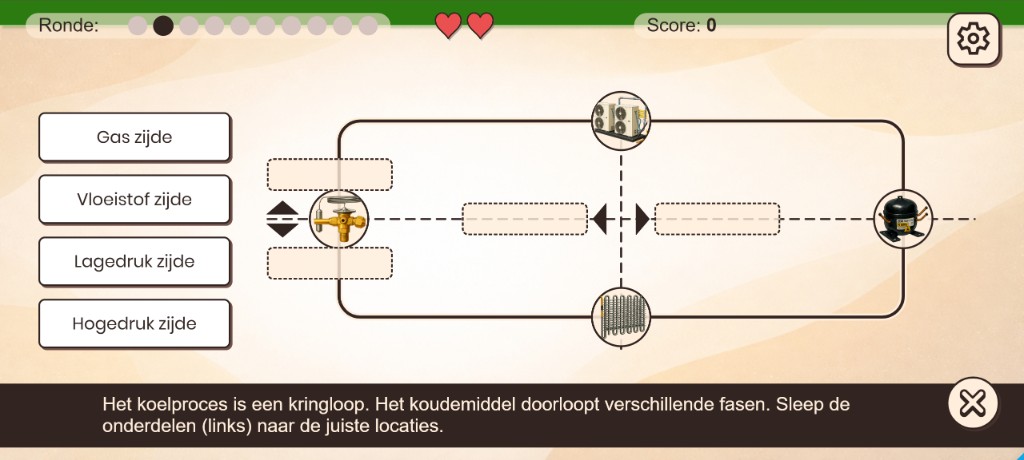
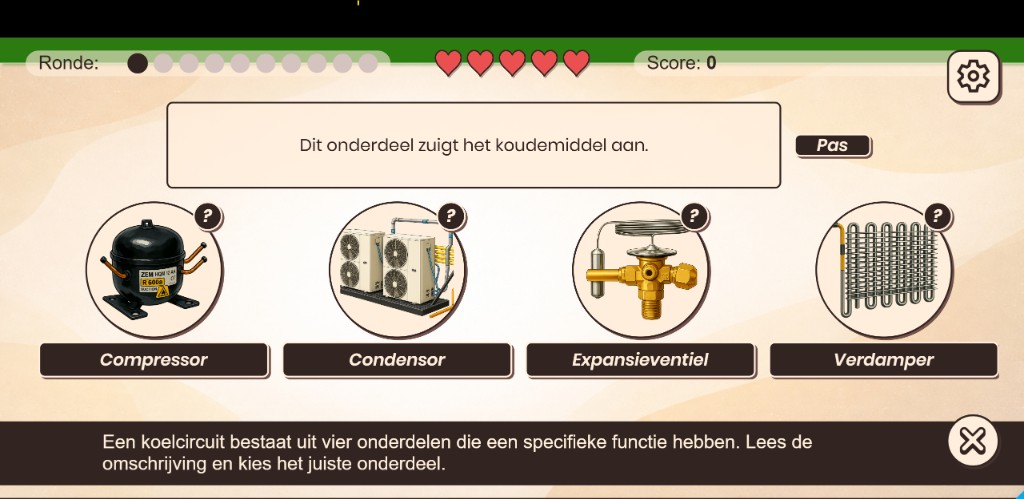
For the Basic Refrigeration Technology project (BRL200), Preludens worked with Climatools BV, 21CC Education and Studium. Topics such as the mechanical cooling process, superheating, subcooling and the h-log-P diagram matter, but can stay abstract when they are offered only through text and explanation.
That is why we developed a series of interactive MicroGames. Participants explore technical processes, recognise connections and apply knowledge in visual tasks. We also developed a game framework that can make progress, performance and learning activity visible.
The project shows how complex professional knowledge can be turned into short, focused learning experiences.
Interactive e-learning does not mean an organisation has to start over completely. Many organisations already have valuable learning content, clear learning goals and an existing digital learning environment.
Preludens helps strengthen that base. We can turn existing knowledge into a MicroGame Story, or develop a separate MicroGame that connects to an existing e-learning module. That adds active practice where it is most valuable.
Our approach is aimed at accessibility. We keep the learning experiences compact, limit unnecessary design complexity and connect to existing learning environments where we can. You can start small and build on those first experiences.
E-learning is the umbrella term for learning through digital means. Game-based learning is a didactic approach that uses principles of play so participants learn actively.
Game-based learning can therefore be part of e-learning. At Preludens we use MicroGames and storytelling to make online learning experiences more active.
The cost depends on the amount of learning content, the complexity of the interactions and the design you want.
At Preludens we work with short, focused MicroGames and MicroGame Stories. We want to make game-based learning accessible without a large serious-game project being required from the start. In a GameStorm we explore which approach fits your learning goals and the means you have.
Our learning experiences can be used in existing learning environments or through our own distribution platform. Which technical connection fits best depends on what that environment allows.
The right form depends on the audience, the learning goals and the context. Not every topic needs an extensive interactive experience. Sometimes a clear explanation is enough. When employees need to practise, weigh options or apply knowledge, MicroGames can be a valuable addition.
Yes. Existing learning content can be the starting point for a new interactive learning experience. We look at which parts lend themselves to active tasks and turn them into fitting stories, challenges and game mechanisms.
Do you want to strengthen existing e-learning or develop new online learning experiences? In a GameStorm we explore your learning challenge together.
We map the audience, the key learning goals and the relevant situations from practice. We then turn those insights into a first storyline and fitting game mechanisms.